

Our Rules
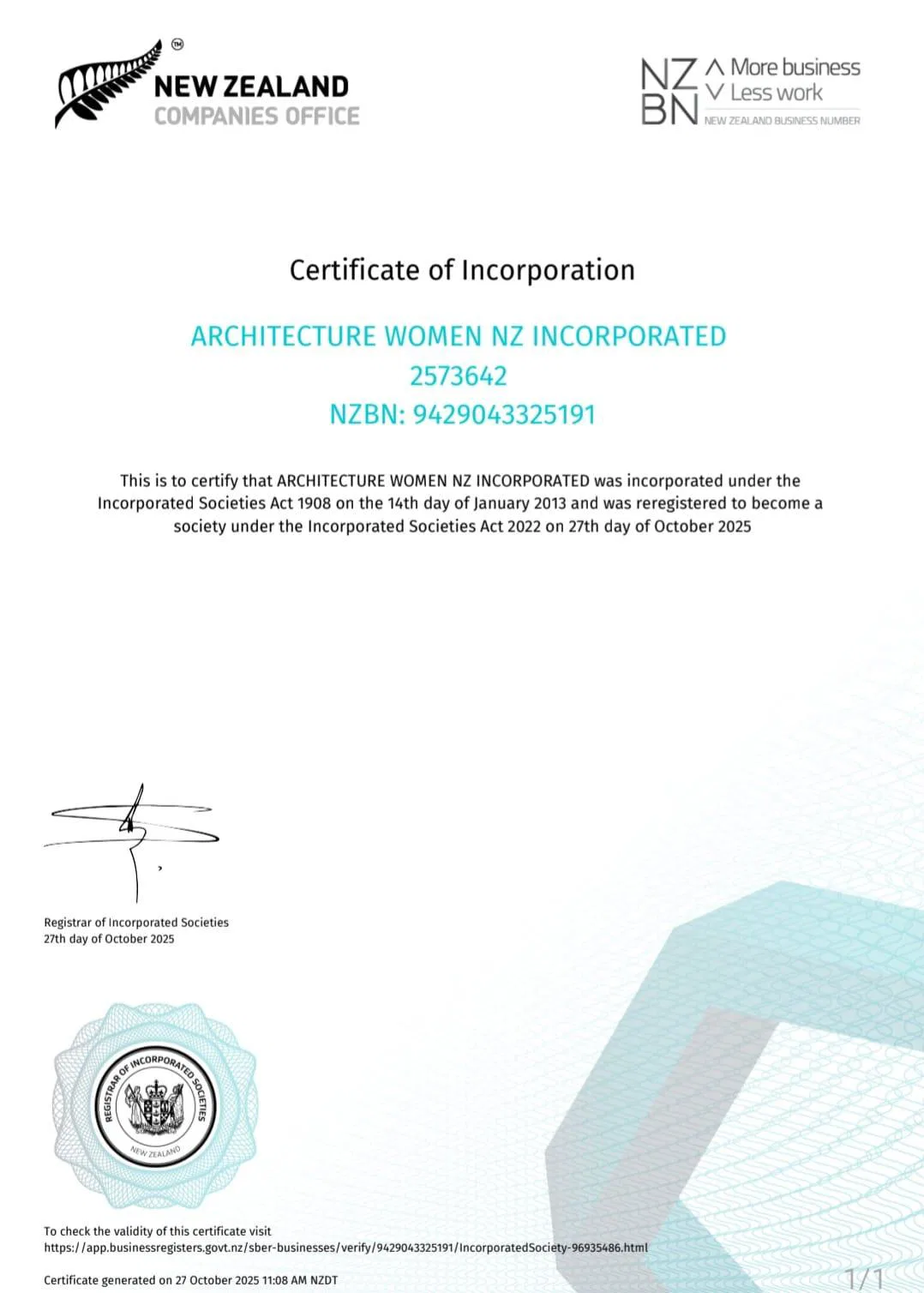
Architecture+Women New Zealand Incorporated Rules1.0 Name:
Architecture Women NZ Incorporated
1.1 Incorporated Society
The Society is not and does not intend to be registered as a charitable entity under the Charities Act 2005.
2.0 Purpose
2.1 The purpose of Architecture Women NZ Inc is to raise the level of visibility of women trained or working in the architectural field, in order to achieve equity, as well as to provide support, advocacy and information.
2.2 The tikanga or culture of the Society is as follows
It is the intention of Architecture Women NZ Inc to be inclusive, as it is recognised that women often have a variety of work/life patterns throughout their careers, and we recognise that our members have a variety of cultural backgrounds.
- 2.2.1 Maintaining free membership for the online database, in the recognition that not all those trained in architecture are working professionals,
- 2.2.2 There is no requirement for members to be currently active in the architectural field.
2.3 Architecture Women NZ Inc is a not for profit. All profits raised by Architecture Women NZ Inc are to be used for the activities and benefit of the Incorporated Society. For further details, see clause 6.1 (Financial) and the Appendix – Operations of the Society: Definitions of Financial Gain.
2.4 Architecture Women NZ Inc focus is on advancing architectural discourse and systems through our research, advocacy, events, and policy work towards a more equitable, inclusive environment, and that reflects Aotearoa New Zealand’s cultural diversity, refer to the A+W NZ Operating Plan
2.5 Architecture Women NZ Inc honour Te Tiriti o Waitangi by seeking guidance from tangata whenua and respect the Te Ao Māori values as they apply to the stewardship of Architecture Women NZ Inc
3.0 Membership
3.1 Membership Criteria
Architecture Women NZ Inc is a not-for-profit organisation made up of voluntary members who meet the following criteria;
- 3.1.1 They have or are working towards a tertiary education in architecture, spatial design, or similar
- 3.1.2 They identify as female, or non-binary
- 3.1.3 They have either trained in New Zealand or reside in New Zealand.
3.2 Membership Registration
To register Architecture Women NZ Inc members upload their details to the online database at www.architecturewomen.org.nz.
Any further information is optional. Database membership is free.
Members can amend, suspend or delete their membership (cease to be a member) at any time by signing in to the Architecture Women NZ Inc website with their own password. No notification is necessary and no costs apply.
- 3.2.1 The Architecture Women NZ Incorporated Society is to have a minimum of 10 members at all times as a requirement of the act.
- 3.2.2 Members are either active and part of the committee, active participating in events and meetings at a national or regional level, or inactive (on database)
- 3.2.3 All Members shall promote the interests and purposes of the Society and shall do nothing to bring the Society into disrepute.
- 3.2.4 No Member is liable for an obligation of the Society by reason only of being a member.
- 3.2.5 If the three criteria for membership are met, exclusion of any member can only occur if they behave in an unlawful manner, or one which is not related to architecture and/or related creative arts or they bring the organisation into disrepute
4.0 Governance
4.1 Officers of the Committee / members
There are to be 3 officers of the committee at all times, a Chairperson (or Co-chairs), a Secretary and a Treasurer, elected by current Architecture Women NZ Inc members.
From the end of each Annual General Meeting until the end of the next, The Officers have the powers necessary for managing, directing and supervising the management of the operation and affairs of the Society, subject to such modifications, exceptions, or limitations in accordance with the Incorporated Societies Act 2022 or in this Constitution.
4.2 Qualifications of officers of the core committee
A person cannot be an Officer if they:
- 4.2.1 Are under 16
- 4.2.2 Are an undischarged bankrupt
- 4.2.3 Are banned from managing companies or charities under NZ law
- 4.2.4 Have, in the last 7 years, been convicted and sentenced for:
- Governance offences under the Act
- Crimes involving dishonesty
- Tax offences
- Similar crimes overseas
- Money laundering or terrorism financing.
- 4.2.5 Are subject to certain legal orders (e.g. banning, forfeiture, or property management), in NZ or an approved overseas jurisdiction
- 4.2.6 Before appointment, the person must:
- 4.2.7 Consent in writing, and
- 4.2.8 Confirm in writing they are not disqualified
Only natural persons can be Officers, and the Society must keep their written confirmation on file.
4.3 Officers Duties
At all times each Officer:
- 4.3.1 shall act in good faith and in what he or she believes to be the best interests of the Society
- 4.3.2 must not act, or agree to the Society acting, in a manner that contravenes the Act or this Constitution,
- 4.3.3 when exercising powers or performing duties as an Officer, must exercise the care and diligence that a reasonable person with the same responsibilities would exercise in the same circumstances taking into account, but without limitation:
- 4.3.3.1 the nature of the Society,
- 4.3.3.2 the nature of the decision, and
- 4.3.3.3 the position of the Officer and the nature of the responsibilities undertaken by him or her
- 4.3.4 must not agree to the activities of the Society being carried on in a manner likely to create a substantial risk of serious loss to the Society or to the Society’s creditors, or cause or allow the activities of the Society to be carried on in a manner likely to create a substantial risk of serious loss to the Society or to the Society’s creditors, and
- 4.3.5 must not agree to the Society incurring an obligation unless he or she believes at that time on reasonable grounds that the Society will be able to perform the obligation when it is required to do so.
4.4 Election or appointment of Officers
The election of Officers shall be conducted as follows.
- 4.4.1 At least 7 Working Days before the date of the Annual General Meeting, the Society shall give Notice to all Members by posting or emailing to them such information as may be supplied to the Society by or on behalf of each nominee, in support of the nomination.
- 4.4.2 Only nominees who are not disqualified from being appointed or holding office as an Officer (as described in the ‘Qualification of Officers’ rule above) may stand for election and vote in elections.
- 4.4.3 If there are insufficient valid nominations received under this rule, but not otherwise, further nominations may be received from the floor at the Annual General Meeting.
- 4.4.4 Votes shall be cast in such a manner as the co-chairs of the Annual General Meeting shall determine.
- 4.4.5 Two Members (who are not nominees) shall act as scrutineers for the counting of the votes and destruction of any voting papers.
- 4.4.6 The failure for any reason of any financial Member to receive such Notice shall not invalidate the election.
- 4.4.7 In the event of any vote being tied the tie shall be resolved by the incoming Committee (excluding those in respect of whom the votes are tied).
In addition to Officers elected under the foregoing provisions of this rule, the Committee may appoint other Officers for a specific purpose, or for a limited period, or generally until the next Annual General Meeting. Unless otherwise specified by the Committee any person so appointed shall have full speaking and voting rights as an Officer of the Society. Any such appointee must, before appointment, supply a signed consent to appointment and a certificate that the nominee is not disqualified from being appointed or holding office as an Officer (as described in the ‘Qualification of Officers’ rule above)
4.5 Term of Officers
The term of office for co-chairs or chairperson elected to the committee shall be no more than 2 years expiring at the end of the Annual General Meeting. Co-chair terms are to be staggered to ensure continuity of operation and knowledge overlapping at change of terms during mid-term cycle. This is to encourage the experience of leadership and governance within the A+W community.
In the event of there being difficulty fulfilling the role of co-chair, current co-chairs can extend their terms in order to find a suitable replacement.
In the event of a Co-chair stepping down during their term refer to clause 4.4 under the Election of appointed officers above.
There are no limitations on time for Treasurer or Secretary roles, but a suggested term of 5 years, for review by the committee.
4.6 Removal of officers
An Officer shall be removed as an Officer by resolution of the Committee or the Society where in the opinion of the Committee or the Society
- 4.6.1 The Officer has brought the Society into disrepute.
- 4.6.2 The Officer has failed to disclose a conflict of interest.
- 4.6.3 The Committee passes a vote of no confidence in the Officer.
with effect from (as applicable) the date specified in a resolution of the Committee or Society.
4.7 Ceasing to hold office
An Officer ceases to hold office when they resign (by notice in writing to the Committee), are removed, die, or otherwise vacate office in accordance with section 50(1) of the Act. Each Officer shall within 10 Working Days of submitting a resignation or ceasing to hold office, deliver to the Committee all books, papers and other property of the Society held by such former Officer.
4.8 Committee and Sub Committees members
The committee is formed of members actively meeting and engaged to promote the purpose of the incorporated society and must be members of the A+W NZ database.
The committee can establish and disestablish sub-committees at any time during the year, as deemed necessary to meet the aims of the incorporated society. Leaders of the sub-committees are to be agreed upon by the co-chairs and committee. The timing of meetings for the committees and/or sub-committees can be determined as necessary by those sub-committees.
A sub-committee must not commit the Society to any financial expenditure without express authority from the committee.
Further information on the roles and responsibilities of the Committee members are outlined in the A+W NZ Operating plan.
4.9 Stopping Committee Membership
A person stops being a Committee Member if:
- 4.9.1 They resign in writing, or
- 4.9.2 Their membership is ended after going through the A+W dispute resolution process in this Constitution,
- 4.9.3 The Committee decides they have damaged the Society’s reputation.
4.10 Rejoining the Committee
A former member can apply to rejoin, following the same process as a new applicant. They can be re-admitted if the Committee agrees.
However, if their membership was ended due to a disciplinary or dispute resolution process, they can only be re-admitted by a vote at a General Meeting, based on the Committee’s recommendation.
4.11 Conflicts of interest
An Officer or member of the committee who is an Interested Member in respect of any Matter being considered by the Society, must disclose details of the nature and extent of the interest (including any monetary value of the interest if it can be quantified)
- 4.11.1 to the Committee and or sub-committee, and
- 4.11.2 in an Interests Register kept by the Committee.
Disclosure must be made as soon as practicable after the Officer or member of a sub-committee becomes aware that they are interested in the matter.
The Committee shall at all times maintain an up-to-date register of the interests disclosed by Officers and by members of any sub-committee.
An Officer or member of a sub-committee who is an Interested Member regarding a Matter—
- must not vote or take part in the decision of the Committee and/or sub-committee relating to the Matter unless all members of the Committee who are not interested in the Matter consent; and
- must not sign any document relating to the entry into a transaction or the initiation of the Matter unless all members of the Committee who are not interested in the Matter consent; but
- may take part in any discussion of the Committee and/or sub-committee relating to the Matter and be present at the time of the decision of the Committee and/or sub-committee (unless the Committee and/or sub-committee decides otherwise).
However, an Officer or member of a sub-committee who is prevented from voting on a Matter may still be counted for the purpose of determining whether there is a quorum at any meeting at which the Matter is considered, where 50 per cent or more of Officers are prevented from voting on a Matter because they are interested in that Matter, a Special General Meeting must be called to consider and determine the Matter, unless all non-interested Officers agree otherwise.
Where 50 per cent or more of the members of a sub-committee are prevented from voting on a Matter because they are interested in that Matter, the Committee shall consider and determine the Matter.
5.0 Meetings
5.1 Committee Meeting
The quorum for a committee meeting is at least two-thirds of the number of members of the Committee in attendance.
The Committee will typically meet at least once a month, except between November and February when only one meeting is required.
Meetings may be held in person or online, with notice given at least 2 Working Days in advance (shorter in urgent cases).
Each Officer has one vote. In the case of a tie, the Co-Chair has the casting vote.
If a Co-Chair is not present at a Committee Meeting, the members of the Committee present may choose one of their number to be Co-Chair of the meeting.
5.2 Annual General Meeting
An Annual General Meeting (AGM) shall be held once a year on a date between the months of April and September and at a location in-person and online determined by the Committee and consistent with any requirements in the Act, and the Constitution relating to the procedure to be followed at General Meetings shall apply.
5.2.1 The Annual General Meeting must be held no later than the earlier of:
- 5.2.1.1 Six months after the balance date of the Society; or
- 5.2.1.2 Fifteen months after the previous AGM
5.2.2 The business of an AGM is to:
- 5.2.2.1 confirm the minutes of the last AGM and any Special General Meeting (s) held since the last AGM;
- 5.2.2.2 adopt the annual report on the operations and affairs of the Society;
- 5.2.2.3 adopt the Committee’s report on the finances of the Society, and the annual financial statements;
- 5.2.2.4 set any subscriptions for the current financial year;
- 5.2.2.5 consider any motions of which prior notice has been given to Members with notice of the Meeting; and
- 5.2.2.6 consider any general business
5.2.3 At each AGM, the Committee must present:
- 5.2.3.1 an annual report on the operation and affairs of the Society during the most recently completed accounting period;
- 5.2.3.2 the annual financial statements for that period; and
- 5.2.3.3 notice of any disclosures of conflicts of interest made by Officers during that period (including a summary of the matters, or types of matters, to which those disclosures relate).
5.3 Special General Meetings
Special General Meetings may be called at any time by the Committee by resolution.
The Committee must call a Special General Meeting if it receives a written request signed by at least 15 Members.
Any resolution or written request must state the business that the Special General Meeting is to deal with.
The rules in this Constitution relating to the procedure to be followed at General Meetings shall apply to a Special General Meeting, and a Special General Meeting shall only consider and deal with the business specified in the Committee’s resolution or the written request by Members for the Meeting.
5.4 Notice of Meetings
The Committee will give all members at least 10 working days' written notice of any Annual or Special Meeting, along with details of the business to be discussed.
This notice will be sent to the contact address listed in the Society’s membership register.
If one or more members do not receive notice, the meeting and its decisions will still be valid.
5.5 Who Can Attend and Vote
Only members may attend, speak, and vote at General Meetings:
- 5.5.1 In person, or online (via real-time audio or visual communication), or
- 5.5.2 by a signed original written proxy (an email or copy not being acceptable) in favour of some individual entitled to be present at the meeting and received by, or handed to, the Committee before the commencement of the General Meeting, or
- 5.5.3 through the authorised representative of a body corporate as notified to the Committee, and
- 5.5.4 no other proxy voting shall be permitted
5.6 Quorum and Meeting Validity
A quorum for General Meetings is 10 eligible members present throughout the meeting.
If a quorum is not met within 30 minutes of the scheduled start:
- 5.6.1 The meeting is cancelled if it was called by member request.
- 5.6.2 Otherwise, it is adjourned to a new time and place set by the Co-Chair.
- 5.6.3 At the adjourned meeting, any number of members present will be considered a quorum.
5.7 Voting
A member is entitled to exercise one vote on any motion at a Meeting in person or by proxy.
Voting shall be by voices or by show of hands or, on demand of the co-chairs or 2 or members present, by secret ballot.
Unless otherwise required by this Constitution, all questions shall be decided by a simple majority of those in attendance in person or by proxy and voting at a meeting or voting by remote ballot.
Written resolutions may not be passed in lieu of a meeting
Any decisions made when a quorum is not present are not valid.
5.8 Meeting Format and Chairing
General Meetings (including AGMs and Special General Meetings) may be held in person, online, or a combination of both. This gives each Member a reasonable opportunity to participate.
All Meetings shall be chaired by a Co-Chair. If the Co-Chair is absent, the Secretary shall chair that meeting.
Any person chairing the Meeting has a deliberative and, in the event of a tied vote, a casting vote.
5.9 Adjournment and Order
The person chairing the Meeting may:
- 5.9.1 With the consent of a simple majority of Members present at any Meeting adjourn the Meeting from time to time and from place to place but no business shall be transacted any adjourned Meeting other than the business left unfinished at the meeting from which the adjournment took place.
- 5.9.2 Direct that any person not entitled to be present at the Meeting, or obstructing the business of the Meeting, or behaving in a disorderly manner, or being abusive, or failing to abide by the directions of the chairperson be removed from the General Meeting, and
5.9.3 In the absence of a quorum or in the case of emergency, adjourn the Meeting or declare it closed.
5.10 Motions
The Committee may propose motions for the Society to vote on (‘Committee Motions’), which shall be notified to Members with the notice of the Meeting.
Any Member may request that a motion be voted on (‘Member’s Motion’) at a Meeting, by giving notice to the Secretary or Committee at least 14 Working Days before that meeting. The Member may also provide information in support of the motion (‘Member’s Information’). If notice of the motion is given to the Secretary or Committee before written Notice of the Meeting is given to Members, notice of the motion shall be provided to Members with the written Notice of the Meeting.
5.11 Minutes
The Society must keep official minutes of all Committee Meetings, including AGMs and Special General Meetings. Minutes will be distributed within a month of the meeting.
6.0 Management
6.1 Financial
- 6.1.1 All income and sponsorship raised on behalf of Architecture Women NZ Inc is to be deposited into the nominated Architecture Women NZ Inc bank account. This account is not to be used for any financial transactions not related to Architecture Women NZ Inc.
- 6.1.2 There must be two approvals for any financial transaction relating to the Architecture Women NZ Inc bank account, and anyone benefiting from a payment must not be one of those approvals.
- 6.1.3 Architecture Women NZ Inc should operate in credit at all times and borrowing funds to meet operating costs is not encouraged. If it is deemed necessary by the core committee that short-term borrowing is necessary, agreement must be reached from the core committee and at least 10 members.
- 6.1.4 Any profits are to remain in the nominated Architecture Women NZ Inc bank account to gain interest for future use by Architecture Women NZ Inc to meet the main objectives of the society. These funds should not be directed into alternative investment accounts.
- 6.1.5 All profits raised by Architecture Women NZ Inc are to be used for the activities and benefit of the Incorporated Society. Architecture Women NZ Inc can employ people, including society members, and pay them for the work they do subject to the following:
- 6.1.5.1 Any income, benefit or advantage shall be applied to the charitable purposes of the organisation.
- 6.1.5.2 No Individual member or associated person shall receive any form of private income, benefit or advantage from the operations.
- 6.1.5.3 No Member of the organisation or any person associated with a member shall participate in or materially influence any decision made by the organisation in respect of the payment to or on behalf of that member or associated person of any income, benefit or advantage whatsoever.
- 6.1.5.4 Any such income paid shall be reasonable and relative to that which would be paid in an arm's-length transaction (being the open market value).
- 6.1.5.5 The provisions and effect of this clause shall not be removed from this document and shall be included and implied in any document replacing this document.
- 6.1.6 All funds shall be applied wholly or principally in New Zealand to promote the objectives and purpose of Architecture Women NZ Inc.
- 6.1.7 The Committee must ensure that there are kept at all times accounting records that:
- 6.1.7.1 correctly record the transactions of the Society;
- 6.1.7.2 allow the Society to produce financial statements that comply with the requirements of the Act; and
- 6.1.7.3 would enable the financial statements to be readily and properly audited (if required under any legislation or the Society's Constitution)
- The Committee must establish and maintain a satisfactory system of control of the Society's accounting records.
- The accounting records must be kept in written form or in a form or manner that is easily accessible and convertible into written form. And the accounting records must be kept for the current accounting period and for the last 7 completed accounting periods of the Society.
- 6.1.8 Annual financial statements are to be prepared by either the Treasurer or an accountant and filed with the Registrar of Incorporated Societies, Ministry of Economic Development. There is no requirement for financial statements to be audited. The financial year shall commence 1 April of each year and ends on 31st March, in accordance with the New Zealand IRD financial year.
6.2 Policies
The Committee from time to time may make and amend policies for the conduct and control of Society activities and codes of conduct applicable to Members, These are to be outlined in the A+W Operating Plan or the A+W Strategic Plan. No such policies or codes of conduct applicable to Members shall be inconsistent with this Constitution, the Act, regulations made under the Act, or any other legislation.
- 6.2.1 All activities of Architecture Women NZ Inc and its members must be lawful.
- 6.2.2 Any activity carried out by Architecture Women NZ Inc must fall within the objectives as stated above and as set out in the rules.
- 6.2.3 Architecture Women NZ Inc is to maintain an identity as a group rather than be a vehicle for personal identification. The intention of this rule is to ensure the A+W·NZ Inc group identity can continue to exist indefinitely, after committee members leave their positions.
6.3 Alterations to the Constitution
Notwithstanding anything to the contrary contained elsewhere in these rules, these rules may only be altered or added to at any meeting if all of the following conditions are fulfilled:
All amendments must be made in accordance with this Constitution. Any minor or technical amendments shall be notified to Members as outlined in section 31 of the Act:
- 6.3.1 At least 10 Working Days before the General Meeting at which any amendment is to be considered the Committee shall give to all Members notice of the proposed resolution, the reasons for the proposal, and any recommendations the Committee has.
- 6.3.2 The core committee unanimously agree to the proposed rule alteration.
- 6.3.3 The Society may amend or replace this Constitution at a General Meeting by a resolution passed by a two-thirds majority of those Members present and voting.
- 6.3.4 No addition to or alteration or rescission of the rules shall be approved if it affects the Benevolent objects (3.0), the personal benefit clause (5.5) or the winding up clause (6.10).
When an amendment is approved by a General Meeting it shall be notified to the Registrar of Incorporated Societies in the form and manner specified in the Act for registration, and shall take effect from the date of registration.
6.4 Intellectual Property
All intellectual property (IP) is owned by the society itself, not its members. This means that any creations, innovations, or trademarks developed by the society, or its members on its behalf, belong to the incorporated entity, not the individuals involved. Shared ownership can be determined and must be agreed to by the committee at the time of creation and documented for future reference.
6.5 Record Keeping
The Architecture Women NZ Inc website (www.architecturewomen.org.nz) is to be maintained in operation as a priority as an up-to-date register of members
6.6 Registered Office/ Contact person
The registered office of the Society shall be at such place in New Zealand as the Committee from time to time determines. A contact person can be appointed by the Committee or elected by the Members at a General Meeting. Each contact person’s name must be provided to the Registrar of Incorporated Societies, along with their contact details.
Any change in that contact person or that person’s name or contact details shall be advised to the Registrar of Incorporated Societies within 20 Working Days of that change occurring, or the Society becoming aware of the change.
Contact information is to be provided on the website 'Contact' page at all times.
website: www.architecturewomen.org.nz
Email: [email protected]
6.7 Access to information for members
A Member may submit a written request to the Society for information, specifying sufficient detail to identify it. The Society must respond within a reasonable time by providing the information, agreeing to provide it within a specified period, or refusing with reasons. The Society may refuse if disclosure would breach privacy, prejudice the commercial or financial interests of the Society or others, be irrelevant, compromise legal privilege, contravene law, impose a disproportionate burden, be frivolous or vexatious, or relate to a dispute or complaint already addressed under the Constitution or the Act.
Nothing in this rule limits Information Privacy Principle 6 of the Privacy Act 2020 relating to access to personal information.
6.8 Disputes
A dispute is a disagreement or conflict involving the Society and/or its Members in relation to specific allegations as set out below.
6.8.1 Raising disputes
- 6.8.1.1 Any grievance by a member, and any complaint by anyone, is to be lodged by the complainant with the Secretary in writing and must provide such details as are necessary to identify the details of the grievance or complaint.
- 6.8.1.2 All Members (including the Committee) are obliged to cooperate to resolve disputes efficiently, fairly, and with minimum disruption to the Society’s activities.
- 6.8.1.3 The complainant raising a grievance or complaint, and the Committee, must consider and discuss whether a grievance or complaint may best be resolved through informal discussions, mediation or arbitration. Where mediation or arbitration is agreed on, the parties will sign a suitable mediation or arbitration agreement.
6.8.2 Investigating disputes
- 6.8.2.1 This rule concerns any grievances of members relating to their rights and interests as Members, and any complaints concerning the alleged conduct or discipline of members, collectively referred to as “disputes.”
- 6.8.2.2 These disputes procedures are designed to enable and facilitate the fair, prompt and efficient resolution of grievances and complaints.
- 6.8.2.3 Rather than investigate and deal with any grievance or complaint, the Committee may:
- 6.8.2.3.a appoint a sub-committee to deal with the same, or
- 6.8.2.3.b refer the same to an external arbitrator, arbitral tribunal, or external visitor (or referee), so long as minimum standards of natural justice and the following requirements under this rule are satisfied,
- 6.8.2.4 The Committee or any such sub-committee or person considering any grievance or complaint is referred to hereafter as the "decision-maker".
6.8.3 Decision-maker
- 6.8.3.1 shall consider whether to investigate and deal with the grievance or complaint, and
- 6.8.3.2 may decline to do so (for instance, if the decision-maker is satisfied that the complainant has insufficient interest in the matter or otherwise lacks standing to raise it; the matter is trivial or does not appear to disclose material misconduct or material; the matter raised appears to be without foundation or there is no apparent evidence to support it; some damage to Members’ interests may arise; or the conduct, incident, event or issue has already been investigated and dealt with by the Society).
- 6.8.3.3 Where the decision-maker decides to investigate and deal with a grievance, the following steps shall be taken:
- 6.8.3.3.a The complainant and the Member, or the Society which is the subject of the grievance, must be advised of all details of the grievance.
- 6.8.3.3.b The Member, or the Society which is the subject of the grievance, must be given an adequate time to prepare a response.
- 6.8.3.3.c The complainant and the Member, or the Society which is the subject of the grievance, must be given an adequate opportunity to be heard, either in writing or at an oral hearing if the decision-maker considers that an oral hearing is required.
- 6.8.3.3.d Any oral hearing shall be held by the decision-maker, and/or any written statement or submissions shall be considered by the decision-maker.
- 6.8.3.4 Where the decision-maker decides to investigate and deal with a complaint, the following steps shall be taken:
- 6.8.3.4.a The complainant and the Member complained against must be advised of all allegations concerning the Member, and all details of the complaint.
- 6.8.3.4.b The Member complained against must be given an adequate time to prepare a response.
- 6.8.3.4.c The Member complained against must be given an adequate opportunity to be heard, either in writing or at an oral hearing if the decision-maker considers that an oral hearing is required.
- 6.8.3.4.d Any oral hearing shall be held by the decision-maker, and/or any written statement or submissions shall be considered by the decision-maker.
6.8.4 A Member may not decide on or participate as a decision-maker in regards to a grievance or complaint, if two or more Committee Members, or the decision-maker, consider that there are reasonable grounds to infer that the person may not approach the grievance or complaint impartially, or without a predetermined view. Such a decision must consider the context of the Society and the particular case and may include consideration of facts known by the other Members about the decision-maker, so long as the decision is reasonably based on evidence that proves or disproves an inference that the decision-maker might not act impartially.
6.8.5 Resolving disputes
- 6.8.5.1 The decision-maker may:
- 6.8.5.1.a dismiss a grievance or complaint, or
- 6.8.5.1.b uphold a grievance and make such directions as the decision-maker thinks appropriate (with which the Society and Members shall comply),
- 6.8.5.1.c uphold a complaint and:
- 6.8.5.1.d reprimand or admonish the Member, and/or
- 6.8.5.1.e suspend the Member from membership for a specified period, or terminate the Member’s membership, and/or
- 6.8.5.1.f order the complainant (if a Member) or the Member complained against, to meet any of the Society’s reasonable costs in dealing with a complaint.
6.9 Liquidation or Removal of Society from the Register
Architecture Women NZ Inc can cease to be an Incorporated Society when the members decide through a voting ballot. On closure, no distribution of assets should be made to any member. On liquidation or removal from the Register of Incorporated Societies all surplus assets (after payment of debts, costs and liabilities) are to be donated to a nominated charitable organisation, within New Zealand, with similar objectives to Architecture Women NZ Inc, which works towards achieving gender equity in the field of architecture and associated creative fields. The funds shall not be disposed of in any other way. In lieu of selecting a similar organisation to Architecture Women NZ Inc the Society may approve distribution to a different not-for-profit entity from that outlined above, so long as the Society complies with this Constitution and the Act in all other respects.
7.0 Definitions
In this Constitution, unless the context requires otherwise, the following words and phrases have the following meanings:
‘Act’ means the Incorporated Societies Act 2022 or any Act which replaces it (including amendments to it from time to time), and any regulations made under the Act or under any Act which replaces it.
‘Annual General Meeting’ means a meeting of the Members of the Society held once per year which, among other things, will receive and consider reports on the Society’s activities and finances.
‘Chairperson’ or ‘Co-Chairperson’ means the Officer responsible for chairing General Meetings and committee meetings, and who provides leadership for the Society.
‘Committee’ means the Society’s governing body.
‘Constitution’ means the rules in this document.
‘Deputy Chairperson’ means the Officer elected or appointed to deputise in the absence of the Chairperson or Co-Chairperson.
‘General Meeting’ means either an Annual General Meeting or a Special General Meeting of the Members of the Society.
‘Interested Member’ means a Member who is interested in a matter for any of the reasons set out in section 62 of the Act.
‘Interests Register’ means the register of interests of Officers, kept under this Constitution and as required by section 73 of the Act.
‘Matter’ means:
- the Society’s performance of its activities or exercise of its powers; or
- an arrangement, agreement, or contract (a transaction) made or entered into, or proposed to be entered into, by the Society.
‘Member’ means a person who has consented to become a Member of the Society and has been properly admitted to the Society who has not ceased to be a Member of the Society. ‘Notice’ to Members includes any notice given by email, post, or courier.
‘Officer’ means a natural person who is:
- a member of the Committee, or
- occupying a position in the Society that allows them to exercise significant influence over the management or administration of the Society, including any Chief Executive or Treasurer.
‘Register of Members’ means the register of Members kept under this Constitution as required by section 79 of the Act.
‘Secretary’ means the Officer responsible for the matters specifically noted in this Constitution.
‘Special General Meeting’ means a meeting of the Members, other than an Annual General Meeting, called for a specific purpose or purposes.
‘Working Days’ mean as defined in the Legislation Act 2019. Examples of days that are not Working Days include, but are not limited to, the following — a Saturday, a Sunday, Waitangi Day, Good Friday, Easter Monday, ANZAC Day, the Sovereign’s birthday, Te Rā Aro ki a Matariki/Matariki Observance Day, and Labour Day.
8.0 Appendix
Operations of the Society - Definitions of Financial Gain
8.1 The Society must not operate for the purpose of, or with the effect of
- 8.1.1 distributing, any gain, profit, surplus, dividend, or other similar financial benefit to any of its Members (whether in money or in kind); or
- 8.1.2 having capital that is divided into shares or stock held by its Members; or
- 8.1.3 holding, property in which its members have a disposable interest (whether directly, or in the form of shares or stock in the capital of the society or otherwise).
8.2 But the Society will not operate for the financial gain of Members simply if the Society
- 8.2.1 engages in trade,
- 8.2.2 pays a Member for matters that are incidental to the purposes of the Society, and the Member is a not-for-profit entity,
- 8.2.3 distributes funds to a Member to further the purposes of the Society, and the Member—
- 8.2.3.1 is a not-for-profit entity, and
- 8.2.3.2 is affiliated or closely related to the Society, and
- 8.2.3.3 has the same, or substantially the same, purposes as those of the Society.
- 8.2.4 reimburses a Member for reasonable expenses legitimately incurred on behalf of the Society or while pursuing the Society’s purposes,
- 8.2.5 provides benefits to members of the public or of a class of the public and those persons include Members or their families,
- 8.2.6 provides benefits to Members or their families to alleviate hardship,
- 8.2.7 provides educational scholarships or grants to Members or their families,
- 8.2.8 pays a Member a salary or wages or other payments for services to the Society on arm’s length terms (terms reasonable in the circumstances if the parties were connected or related only by the transaction in question, each acting independently, and each acting in its own best interests; or are terms less favourable to the Member than those terms and the payment for services, or other transaction, does not include any share of a gain, profit, or surplus, percentage of revenue, or other reward in connection with any gain, profit, surplus, or revenue of the Society),
- 8.2.9 provides a Member with incidental benefits (for example, trophies, prizes, or discounts on products or services) in accordance with the purposes of the Society.
- 8.2.10 on removal of the Society from the Register of Incorporated Societies having its surplus assets distributed under subpart 5 of Part 5 of the Act to a Member that is a not-for-profit entity.
Architecture Woman NZ Incorporated
In Association With











Join our newsletter