

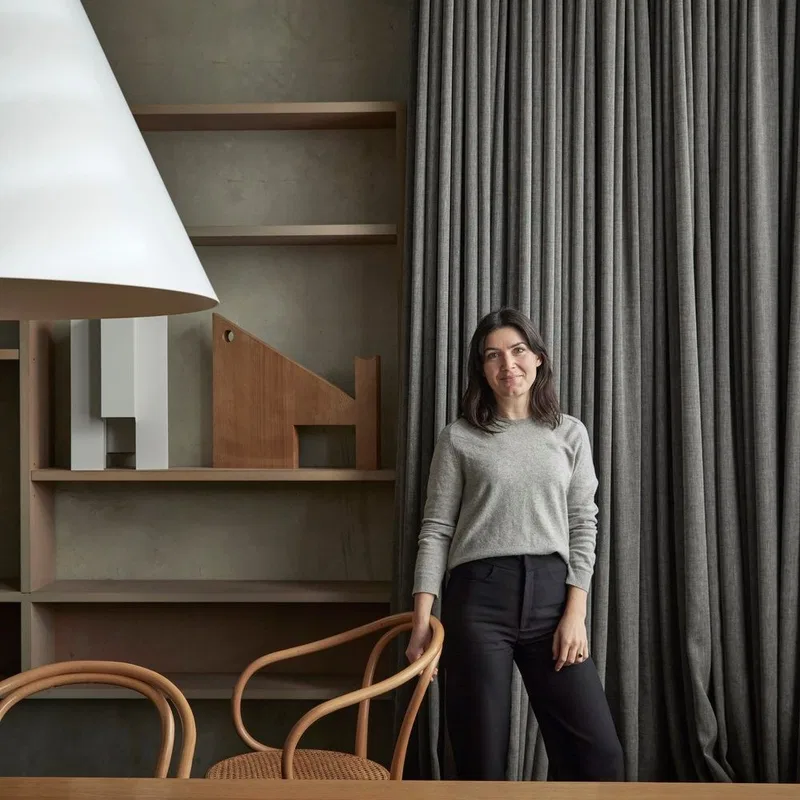
(Acting) Strategic Design Lead & Senior Architect at City of Melbourne.
ARBV Registered Architect (Victoria, Australia)
ARBV Registered Architect (Victoria, Australia)
Available to Mentor
With over a decade of experience at leading Victorian practices including Kennedy Nolan, Fieldwork, and NMBW, I bring a design approach that balances technical expertise and conceptual fun.
My career has evolved from residential work into the public sector, currently serving as a Senior Architect and Acting Strategic Design Lead for the City of Melbourne. I oversee diverse municipal projects, from Community Hubs to small-scale infrastructure for the city.
I am passionate about the civic impact of design in the built and natural environment. Reach out if you would like to have a chat.
Showcase
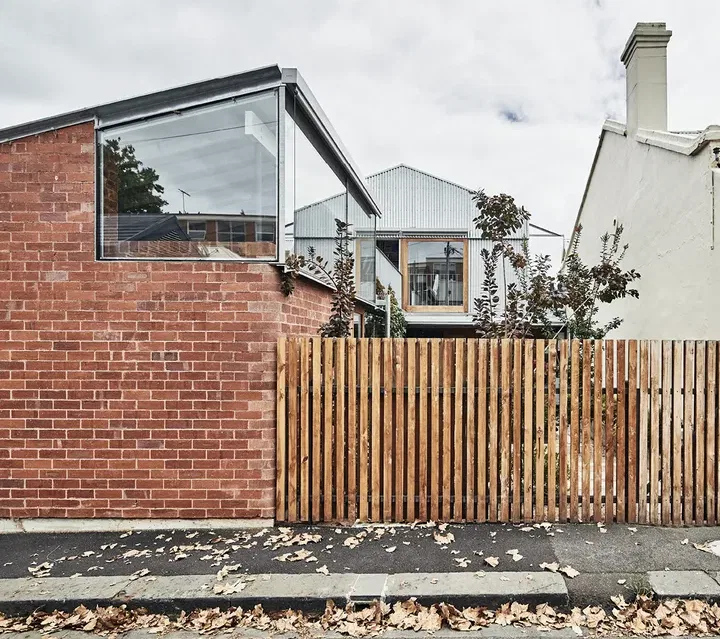
North Melbourne House
This project consolidates two adjacent blocks. Together, the two dwellings, one old and one new, are conceived as a ‘share-house for ageing-in’. Two kitchens are separated by small courtyards allowing for either two independent households to share open spaces or four smaller sub-households (such as individual sub-tenants or an elderly couple) to live semi-independently with use of the double site. Rooms are configured to allow a range of flexible household configurations and fully accessible ageing-in place. The design is structured around the central courtyard, which provides quality private open space for residents, and contributes to the amenity and greenery of the of the heritage streetscape.
Year of Completition
2016
Type
Residential
Role
Architectural Graduate
Collingwood Yards
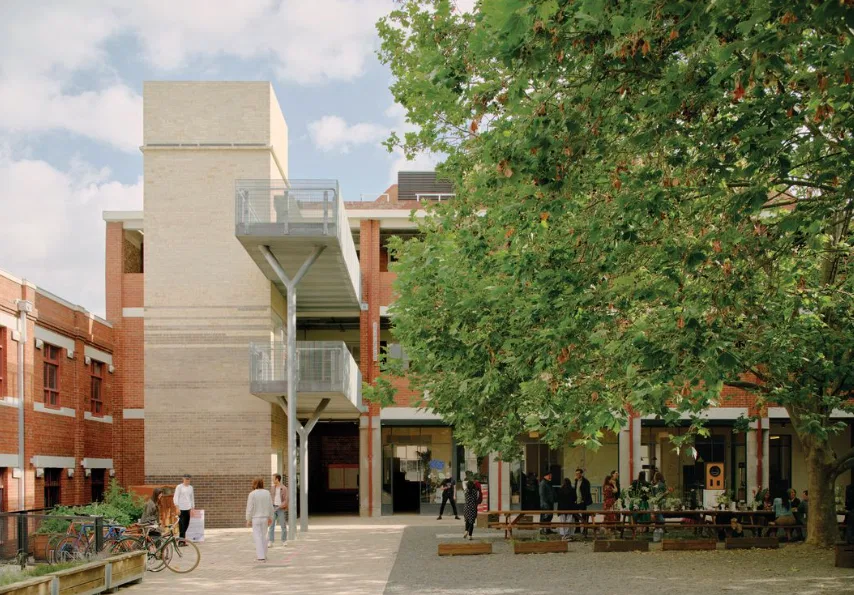
Situated on the traditional lands of the Wurundjeri People of the Kulin Nation, Collingwood Yards is the first of its kind in Australia; a new contemporary arts precinct emulating internationally successful and self-sufficient social enterprise models. The former Collingwood Technical College has been redeveloped into a major new creative hub offering secure and affordable tenancies for artists, arts organisations and creative enterprises.
Our vision of Collingwood Yards was developed through a study of the urban ecology of Collingwood and in consultation with artists, musicians, curators and indigenous urban planners to understand the needs of contemporary practitioners and organisations.
Our approach to working with the existing fabric was one of minimal intervention. We used design strategies to preserve the sense of discovery and patina of the old buildings, without ossifying them as relics or simply preserving them. Through our design we tried to frame and highlight existing ‘banal’ features, while making new work distinct.
Our vision of Collingwood Yards was developed through a study of the urban ecology of Collingwood and in consultation with artists, musicians, curators and indigenous urban planners to understand the needs of contemporary practitioners and organisations.
Our approach to working with the existing fabric was one of minimal intervention. We used design strategies to preserve the sense of discovery and patina of the old buildings, without ossifying them as relics or simply preserving them. Through our design we tried to frame and highlight existing ‘banal’ features, while making new work distinct.
Year of Completition
2021
Type
Public / Cultural
Role
Architect
Melbourne Place
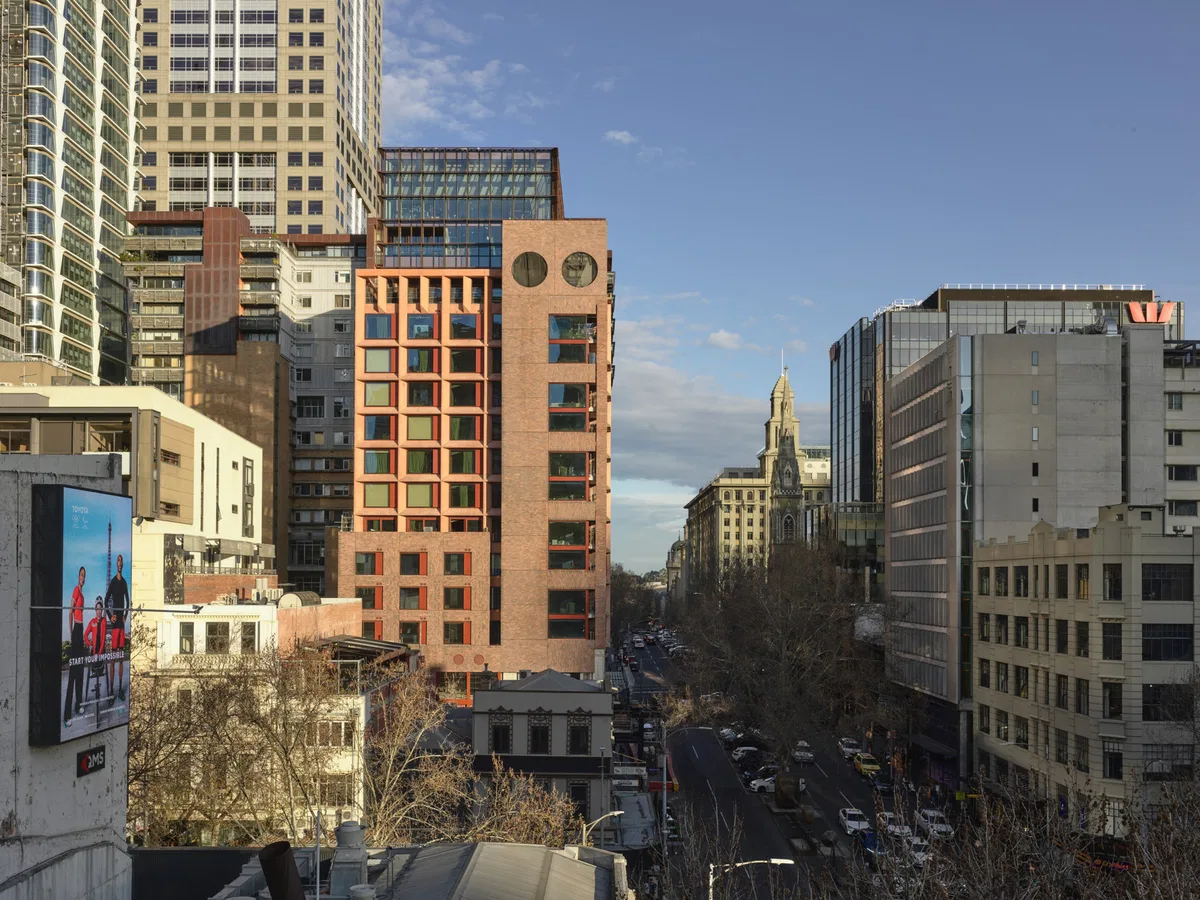
Melbourne Place is a new independent hotel accommodated in a “complete design”, a new building with fully integrated interiors, carried out by a single team. Our work included collaborating on the development of the hotel brand in conjunction with Client Josh Taylor, brand agency Studio Round and Hotel Managing Director Tracy Atherton. The design of the building, the interiors and the hotel brand have informed each other from the very beginning such that the identity of this hotel is expressed in every part of the physical object. Sensibilities around space, volume, light, colour, texture and detail are consistent from the urban scale down to the cabinet hardware lending a sense of substance, a complete vision, each element reinforcing and amplifying the unique character of the place.
The design of the building derives from the particular architectural and cultural identity of Melbourne generally but more specifically, the actual site in the east-end of the CBD. The mass and detail have a twentieth century quality, reinforced by the highly modelled tinted concrete and brick façade and the operable shutters to every guest-room. This architectural expression aims to position Melbourne Place amongst an esteemed lineage of some significant nearby buildings – The T&G building, Cavendish House and right next door, Hero, the old Russell St telephone exchange.
The sixteen-level building includes two basement levels, a double-height scaled ground plane engaged on it’s three outward-facing sides, a first-floor balcony projecting over Russell Street and a three-level “top-knot” recessed form the street wall and formed in a gauzey corten brise-soleil.
While we focussed on making a ‘polite’ building, a seemly neighbour, we also aspired to imbuing it with a personality so that it could be a familiar friend to Melburnians, a vessel for great hospitality which would be recognisable, even memorable. A persona is embedded in the very structure, an abstract zoomorphic form with a long brick neck and a set of super-scaled eyes looking out to the north. This persona formed a conceptual basis for every design question and as the design evolved the original idea and the intrinsic personality of the building emerged.
The building is tonal, muted and natural, made from bricks developed for the project (with Kraus bricks in Stawell) and warmly tinted pre-cast concrete, highlighted with deep red metal accents and window frames. The bricks flow into the interiors where they meet colour – sometimes intense, sometimes playful, designed to lodge in the memory. Interior colour is set against large areas of complementary natural materials – West Australian jarrah, locally sourced terrazzo in blends developed specifically for Melbourne Place and metallic accents in brass and corten steel. Fixtures, fittings, lights, carpets and furniture have largely been sourced from local makers and designers, many made specifically for Melbourne Place. Local artists have been commissioned, not simply to adorn, but to represent Melbourne culture – contemporary, sophisticated, urban, multi-cultural and grounded in the lands of the world’s oldest continuous living culture. The effect is visually fresh but uncannily familiar, an authentic representation of place.
The design of the building derives from the particular architectural and cultural identity of Melbourne generally but more specifically, the actual site in the east-end of the CBD. The mass and detail have a twentieth century quality, reinforced by the highly modelled tinted concrete and brick façade and the operable shutters to every guest-room. This architectural expression aims to position Melbourne Place amongst an esteemed lineage of some significant nearby buildings – The T&G building, Cavendish House and right next door, Hero, the old Russell St telephone exchange.
The sixteen-level building includes two basement levels, a double-height scaled ground plane engaged on it’s three outward-facing sides, a first-floor balcony projecting over Russell Street and a three-level “top-knot” recessed form the street wall and formed in a gauzey corten brise-soleil.
While we focussed on making a ‘polite’ building, a seemly neighbour, we also aspired to imbuing it with a personality so that it could be a familiar friend to Melburnians, a vessel for great hospitality which would be recognisable, even memorable. A persona is embedded in the very structure, an abstract zoomorphic form with a long brick neck and a set of super-scaled eyes looking out to the north. This persona formed a conceptual basis for every design question and as the design evolved the original idea and the intrinsic personality of the building emerged.
The building is tonal, muted and natural, made from bricks developed for the project (with Kraus bricks in Stawell) and warmly tinted pre-cast concrete, highlighted with deep red metal accents and window frames. The bricks flow into the interiors where they meet colour – sometimes intense, sometimes playful, designed to lodge in the memory. Interior colour is set against large areas of complementary natural materials – West Australian jarrah, locally sourced terrazzo in blends developed specifically for Melbourne Place and metallic accents in brass and corten steel. Fixtures, fittings, lights, carpets and furniture have largely been sourced from local makers and designers, many made specifically for Melbourne Place. Local artists have been commissioned, not simply to adorn, but to represent Melbourne culture – contemporary, sophisticated, urban, multi-cultural and grounded in the lands of the world’s oldest continuous living culture. The effect is visually fresh but uncannily familiar, an authentic representation of place.
Year of Completition
2024
Type
Commercial
Role
Project Architect
Fairlie Apartment Interior
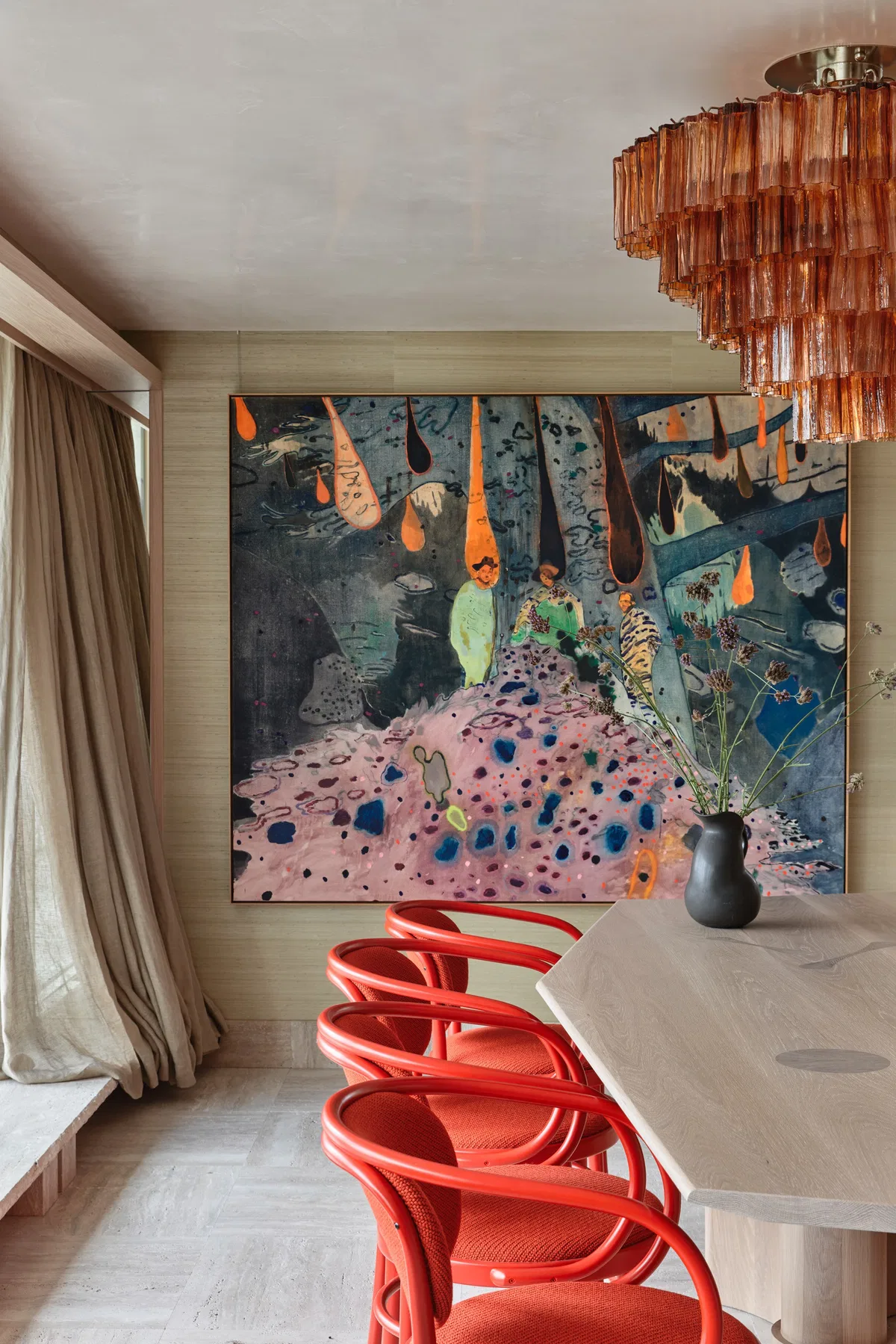
This apartment interior can be found in one of the most celebrated apartment buildings in Melbourne, Fairlie, by the venerable modernists Yuncken Freeman Bothers, Griffiths and Simpson. The hyper-refined Regency flavour of the late-modernist building sets the tone for a thorough re-imagining of what was a much-altered apartment. The building envelope includes a north and east elevation as well as a truly spectacular western elevation perched above Guilfoyle’s Volcano in the Melbourne Royal Botanic Gardens. The deep vista includes the full length of the gardens, the tower of Government House rising from the canopy, the MCG visible to the north and the dramatic cliff-like panorama of the CBD as a glittering, distant backdrop.
Put simply, the brief was for a down-size apartment for a client transitioning from a large house and garden which came with a lifetime of carefully and intelligently collected art and furniture. Initial discussions ranged wide with an interested and interesting Client. Some of the outcomes of these discussions were around the specifics of domestic habitation, requirements informed and honed through previous architectural commissions, but there was also a keen exploration of thematic and conceptual matters.
Our first move was spatial, a desire to break down the cellular plan and introduce enfilades which would reveal the triple aspect of the floor-plate but also acknowledge the way an apartment can be inhabited as a variegated progression through a continuous space. The collection of furniture and art our Clients brought with them suggested a design methodology – the creation of an interior in the manner of a Wunderkammer or a series of armatures in the manner of Sir John Soane’s house museum.
The nexus of a decorative late-modernist building, definitive spatial planning and a desire to make a setting for art, objects and furniture came together in a particular way. Materiality, texture, surface and colour draw on the tertiary hues of late modernism and the luxurious intensity of a design movement at its hedonistic zenith – an approach epitomized by the extensive use of that most bourgeois of tones - beige. Enfilade planning opens up the interior and de-limits horizontal space, a progression which is enlivened through intense but purposefully muted colour and texture at the entry and in the snug. And finally, the impact of precious objects is heightened through designation of specific places – plinths, platforms and ledges, but also through an elevated entourage of grasscloth, raw linen, limed oak and polished plaster.
This apartment is civilized in the very best sense, it is not vulgar luxury, rather it reflects a thoughtful and cultivated approach to living beautifully and well.
Put simply, the brief was for a down-size apartment for a client transitioning from a large house and garden which came with a lifetime of carefully and intelligently collected art and furniture. Initial discussions ranged wide with an interested and interesting Client. Some of the outcomes of these discussions were around the specifics of domestic habitation, requirements informed and honed through previous architectural commissions, but there was also a keen exploration of thematic and conceptual matters.
Our first move was spatial, a desire to break down the cellular plan and introduce enfilades which would reveal the triple aspect of the floor-plate but also acknowledge the way an apartment can be inhabited as a variegated progression through a continuous space. The collection of furniture and art our Clients brought with them suggested a design methodology – the creation of an interior in the manner of a Wunderkammer or a series of armatures in the manner of Sir John Soane’s house museum.
The nexus of a decorative late-modernist building, definitive spatial planning and a desire to make a setting for art, objects and furniture came together in a particular way. Materiality, texture, surface and colour draw on the tertiary hues of late modernism and the luxurious intensity of a design movement at its hedonistic zenith – an approach epitomized by the extensive use of that most bourgeois of tones - beige. Enfilade planning opens up the interior and de-limits horizontal space, a progression which is enlivened through intense but purposefully muted colour and texture at the entry and in the snug. And finally, the impact of precious objects is heightened through designation of specific places – plinths, platforms and ledges, but also through an elevated entourage of grasscloth, raw linen, limed oak and polished plaster.
This apartment is civilized in the very best sense, it is not vulgar luxury, rather it reflects a thoughtful and cultivated approach to living beautifully and well.
Year of Completition
2024
Type
Interiors
Role
Project Architect
Nightingale Village
Nightingale is a model for triple bottom line developments. The development is led by the Architect to produce medium density housing that is environmentally, socially and financially sustainable. Combining ethical investors and best practice in design, the ultimate goal of Nightingale is to provide great value housing by simplifying both the development process and the building itself.
Kennedy Nolan’s work in single and multi-residential projects; our exploration of interiors and landscape; our experience delivering a conventional development product, and our own investment in other Nightingale projects, led us to a Nightingale License in 2016. The following year, we purchased a site in a precinct shared with six other Architects. Alongside our professional contemporaries, we are contributing to an exciting urban village beside the Upfield train line in Brunswick, in the inner north of Melbourne.
The building consists of 28 apartments, ranging from small 34 sqm ‘teilhaus’ (studio) apartments to generous (80 sqm) 2 bedroom apartments. The building will be an exemplar in sustainable design (including a 7.5 star NatHERS thermal rating, 100% fossil fuel free in operation, zero private car parking and access to a shared basement with 15 car share vehicles). 20% of the apartments have been voluntarily pre allocated to an affordable housing provider and purchaser priority is given to key service workers, individuals with a disability and Aboriginal and Torres Straight Islanders.
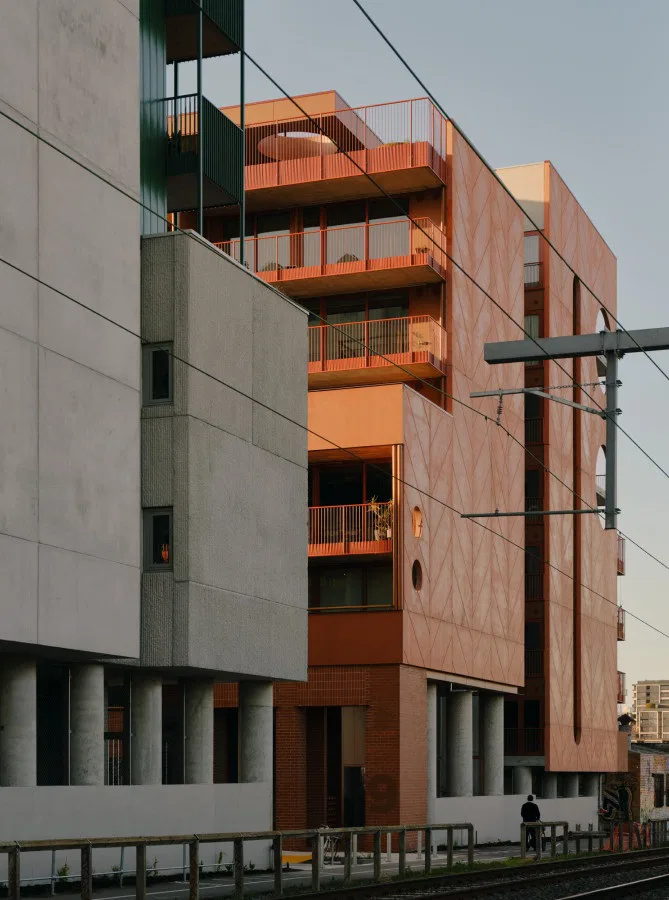
Essentially, the Nightingale principle is to do more with less and for us this meant identifying fundamental parts of the building and thinking about ways to manipulate or deploy them to make our Nightingale feel domestic, warm, textural and particular. We tinted our grey pre-cast a warm pink and built a tonal palette of deep ochre windows, classic pressed-red bricks (very vernacular to Melbourne) and dark red balustrades. These elements are arranged with a playful approach, particularly on our west façade which has a friendly personality through its zoomorphic composition.
We made the interiors soft and warm, not too bright, eliminating white and using muted colour and graphic elements – a careful consideration of timber, cork, terrazzo, brass and wool which has all the attention and textural focus of our most celebrated single residential projects.
This is a building designed with community in mind, a community that is diverse, cohesive and connected. We are proud to have delivered 28 homes which have the comfort, delight and function for which our practice is known.
Kennedy Nolan’s work in single and multi-residential projects; our exploration of interiors and landscape; our experience delivering a conventional development product, and our own investment in other Nightingale projects, led us to a Nightingale License in 2016. The following year, we purchased a site in a precinct shared with six other Architects. Alongside our professional contemporaries, we are contributing to an exciting urban village beside the Upfield train line in Brunswick, in the inner north of Melbourne.
The building consists of 28 apartments, ranging from small 34 sqm ‘teilhaus’ (studio) apartments to generous (80 sqm) 2 bedroom apartments. The building will be an exemplar in sustainable design (including a 7.5 star NatHERS thermal rating, 100% fossil fuel free in operation, zero private car parking and access to a shared basement with 15 car share vehicles). 20% of the apartments have been voluntarily pre allocated to an affordable housing provider and purchaser priority is given to key service workers, individuals with a disability and Aboriginal and Torres Straight Islanders.
Essentially, the Nightingale principle is to do more with less and for us this meant identifying fundamental parts of the building and thinking about ways to manipulate or deploy them to make our Nightingale feel domestic, warm, textural and particular. We tinted our grey pre-cast a warm pink and built a tonal palette of deep ochre windows, classic pressed-red bricks (very vernacular to Melbourne) and dark red balustrades. These elements are arranged with a playful approach, particularly on our west façade which has a friendly personality through its zoomorphic composition.
We made the interiors soft and warm, not too bright, eliminating white and using muted colour and graphic elements – a careful consideration of timber, cork, terrazzo, brass and wool which has all the attention and textural focus of our most celebrated single residential projects.
This is a building designed with community in mind, a community that is diverse, cohesive and connected. We are proud to have delivered 28 homes which have the comfort, delight and function for which our practice is known.
Year of Completition
2022
Type
Multi-Residential & Urban
Role
Project Architect
In Association With









Join our newsletter